.png) Halal Certified Bakery
Halal Certified Bakery HPB Healthier Choice Bakery Partner
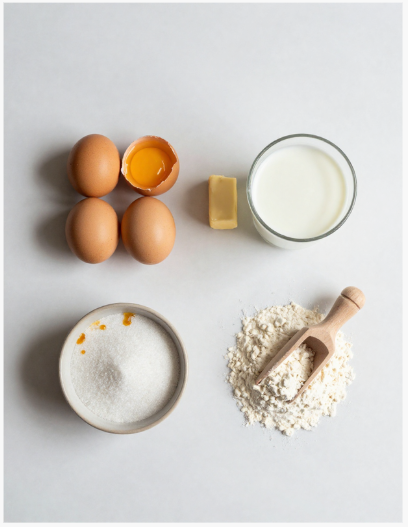
If you remove the eggs, dairy and refined sugar from a cake, what is left?
For us, the more useful question has always been: what do you replace them with?
That question has shaped a lot of the work we do at Delcie’s.
When people hear “eggless”, “dairy-free”, “lower sugar” or “gluten-free”, it is easy to imagine that baking for different dietary needs is simply about leaving certain ingredients out.
In reality, those ingredients all have jobs to do.
Eggs can help with structure and binding. Dairy contributes moisture and richness. Sugar affects much more than sweetness — it also influences texture, browning and softness. Wheat flour gives a conventional cake much of its structure.
Once several of those ingredients are removed, you cannot expect the original recipe to behave in the same way.
You have to rebuild it.
That was one of the topics Delcie recently spoke about during a food and nutrition session with Allkin seniors: what really happens when we remove familiar ingredients from food, and how do we decide what should take their place?
Removing sugar is only one part of the picture
For many customers looking for a healthier cake, sugar is one of the first things they think about.
It is an important consideration, but it is not the only one.
The overall nutritional profile of a food also depends on things such as carbohydrate content, fibre, fat, sodium, serving size and the ingredients used throughout the recipe.
This is why we do not look at cake formulation as simply:
less sugar = healthier cake.
We are more interested in the bigger question: can we create something more thoughtfully formulated while still making a cake people genuinely enjoy eating?
Depending on the product, that may involve looking at alternative sweeteners, wholegrains, plant-based ingredients, fruit, different flours or other changes to the formulation.
Some of our ranges are also developed with more specific dietary considerations in mind, including Low GI options.
That said, there is no single cake that is automatically suitable for everyone. Someone managing diabetes, for example, still needs to consider portion size, total carbohydrate intake and their own dietary or medical needs.
The label is useful. It should never replace the bigger picture.
Why replacing an ingredient is harder than removing it
Take eggs as an example.
In a conventional cake, eggs may help to bind ingredients together, provide structure, retain moisture and support the texture of the finished bake.
If you remove the egg, something else has to take over those functions.
Then imagine removing dairy as well.
Perhaps you also want to change the type or amount of sweetener.
And if the cake also needs to be gluten-free, you have another structural challenge to solve.
This is why specialised baking is rarely about finding one substitute and swapping it into an existing recipe.
The whole recipe has to work together.
The real work is in finding the right balance of ingredients so that the cake still has the softness, moisture, flavour and mouthfeel people expect.
That process involves a lot of testing.
Gluten-free cakes are a good example
Wheat flour contains gluten, which contributes much of the structure people are familiar with in a conventional cake.
Replacing wheat flour with one gluten-free flour does not necessarily produce the same result.
In our gluten-free cakes, we use a formulated blend that can include ingredients such as whole-grain sorghum flour, brown rice flour, potato starch, tapioca flour and xanthan gum.
Each ingredient contributes something different.
One may help with structure, another with softness, another with elasticity or texture.
The point is not simply to find a flour that does not contain gluten.
It is to understand what the finished cake needs, and then build a combination of ingredients that can deliver it.
That same principle applies across many of our recipes.
A dietary-friendly cake still has to taste like cake
This part matters a lot to us.
A birthday cake should still feel like a birthday cake.
Chocolate should taste properly chocolatey.
Fruit flavours should taste bright and fresh.
The sponge should be enjoyable to eat, and the cream and fillings should work with it.
We never want the reaction to be:
“This is good… considering it is a healthier cake.”
We want it to be good cake.
That is why taste and texture are not secondary considerations in our recipe development. They are part of the same problem we are trying to solve.
Removing an ingredient is relatively easy.
Removing it while still creating something people genuinely want another slice of is much harder.
Nutrition and pastry have to work together
People sometimes talk about nutrition and indulgence as though they have to sit at opposite ends of the table.
We do not think it is that simple.
Nutrition helps us think more carefully about what goes into a product.
Pastry science helps us make sure those choices still result in something enjoyable.
Different dietary needs also require different approaches.
A gluten-free cake presents a different challenge from an eggless cake.
A lower-carbohydrate recipe may call for a different combination of flours and sweeteners.
A baby-friendly cake has another set of considerations again.
There is no single ingredient replacement that works for every cake and every customer.
The formulation has to start with the person the cake is being made for.
Why clear ingredient information matters
Another topic Delcie discussed during the Allkin session was food labels.
Marketing claims can be useful, but they do not tell the whole story.
Looking at the ingredient list and nutrition information gives much more context.
For prepacked foods in Singapore, ingredients are generally listed in descending order by weight, so the first few ingredients can tell you a lot about what makes up the product.
Serving size matters too.
A nutrition panel may look very different depending on whether you are reading the information per serving or for the whole package.
We believe that transparency is especially important when people are choosing products because of dietary restrictions.
Terms such as “healthy”, “low sugar” or “sugar-free” should not replace understanding what is actually in the food.
For people managing medical conditions, their own dietary needs and professional advice should always come first.
“Healthier” means different things to different people
One reason people come to Delcie’s is that they are often looking for very different things.
One family may need a cake without eggs and dairy.
Another may be looking for a gluten-free option.
Someone else may be searching for a Low GI or diabetic-friendly cake.
Parents may be looking for cakes developed specifically for younger children.
Schools, childcare centres and companies may need options that work across several dietary requirements while also meeting Halal requirements.
Delcie’s is Halal-certified, and our range includes options across different dietary needs such as eggless, dairy-free, gluten-free, diabetic-friendly, Low GI, nut-free and baby-friendly products.
Not every product meets every one of those requirements, which is why we always encourage customers to check the individual product details rather than assuming that one label covers everything.
Sensitive-diet baking is also about what happens in the kitchen
The recipe itself is only part of the picture.
Production processes matter too.
For example, we separate gluten-free and wheat-free baking and washing utensils during production to reduce the risk of cross-contact.
At the same time, our facility does handle allergens including nuts, gluten and soy, so we do not claim that cross-contact can be completely eliminated.
For customers with severe allergies, we always recommend speaking with our team before ordering so we can explain what we can and cannot accommodate.
We would rather be clear about our limitations than make a promise our kitchen cannot support.
More than 15 years of learning what works
Delcie founded Delcie’s Desserts and Cakes in 2008.
Since then, the bakery has spent years developing cakes for people who are often left out of conventional celebrations because of their dietary requirements.
That has meant experimenting with egg-free and dairy-free baking, alternative sweeteners, gluten-free formulations, Low GI products and other recipes developed around different needs.
In 2011, Delcie’s became Singapore’s first bakery to become a Healthier Choice partner with the Health Promotion Board and the first recipient of the Healthier Bakery Award.
But after all those years of recipe development, one lesson has remained consistent:
You cannot make a good cake simply by taking ingredients away.
You have to understand what those ingredients were doing in the first place.
Then you have to decide, carefully, what should take their place.
So what makes a better cake?
For us, it is not about having the longest list of health claims or removing as many ingredients as possible.
It is about making deliberate choices.
What have we removed?
Why have we removed it?
What replaces the function it used to perform?
Does the finished product suit the dietary need it was designed for?
Is the information clear enough for the customer to make an informed choice?
And, importantly:
Does it still taste good?
Because most people are not eating cake as a nutrition exercise.
They are eating it at birthdays, weddings, school parties, office celebrations and family milestones.
Someone with a dietary restriction should not have to feel that they are receiving the “alternative” dessert while everybody else gets the real one.
That is what we are ultimately trying to change.
At Delcie’s, our cakes are not simply conventional cakes with ingredients removed.
They have been reformulated around the people who need them.
And after more than 15 years of doing this, we still believe that everyone deserves to have a slice.
Looking for a cake for a specific dietary need? Explore Delcie’s range of eggless, dairy-free, gluten-free, Low GI, diabetic-friendly, baby-friendly and other sensitive-diet cakes, or speak with our team if you are unsure which range is suitable for you.
Frequently Asked Questions
Are all Delcie’s cakes eggless and dairy-free?
Yes. Delcie’s cakes are plant-based and made without eggs or dairy. Other dietary characteristics differ between products, so customers looking for gluten-free, nut-free or other specific options should check the individual product information.
Does Delcie’s have cakes for people looking for lower-sugar or Low GI options?
Yes. Delcie’s has ranges developed with different nutritional considerations in mind, including Low GI and diabetic-friendly options. These labels should still be considered together with serving size, overall carbohydrate intake and individual dietary needs.
Are Delcie’s cakes gluten-free?
Some ranges are gluten-free, but not every product is. Check the individual product description when ordering.
Can Delcie’s cater for severe food allergies?
Our kitchen handles allergens including nuts, gluten and soy. We use processes designed to reduce cross-contact for certain product ranges, but cannot guarantee that cross-contact will never occur. Customers with severe allergies should speak with our team before placing an order.
Is Delcie’s Halal-certified?
Yes. Delcie’s Desserts and Cakes is Halal-certified in Singapore.